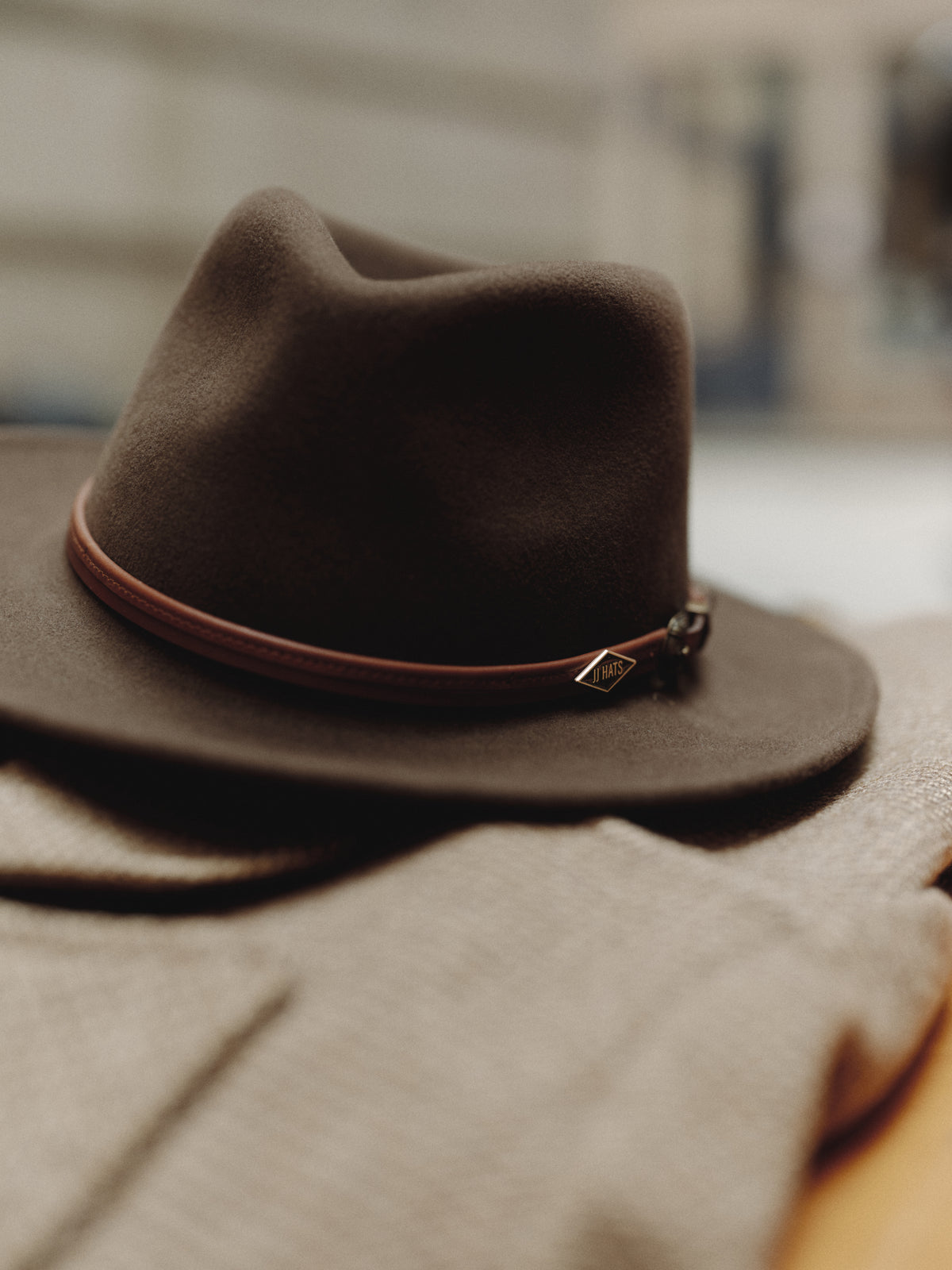
What is a top hat? It is a stiff hat with a tall, cylindrical, flat-topped crown, a narrow brim turned up at the sides and a grosgrain ribbon. Born at the end of the 18th century, it established itself in the 19th as the town hat of the elegant gentleman, before becoming the centrepiece of the most formal attire: morning dress, white tie, grand weddings and race meetings.
At JJ Hat Center, a luxury hatter, the top hat holds a place of its own: it is not an everyday hat, but the one you choose for a moment that matters. This guide explains how to recognise it, where it comes from, when to wear it and how it differs from the bowler hat. To explore the models available, visit our selection of top hats.
What is a top hat: definition and anatomy
A top hat is recognisable at first glance by its vertical silhouette. Four elements define it:
- The crown: tall, cylindrical, with a perfectly flat top. It may be straight or slightly flared towards the top, which refines the line.
- The brim: narrow, bound, turned up at the sides and dipping slightly at the front and back. This curve is one of the signatures of the style.
- The hatband: an understated grosgrain band, usually tone on tone, finished with a flat bow.
- The interior: a leather sweatband that ensures a secure fit and comfort, and a satin lining that protects the hair.
The materials: from beaver to silk, then to felt
The first top hats were made of beaver felt, a dense material that is naturally resistant to rain. During the 19th century, silk plush in a deep, glossy black, stretched over a rigid shell of shellac-stiffened cloth, became the benchmark. As this plush is no longer woven today, antique silk top hats have become collector’s pieces. Contemporary top hats are most often made of fur felt or wool felt, velvety to the touch and impeccable in shape.
The main variants
- The black top hat: the most formal, associated with white tie and solemn ceremonies.
- The grey top hat: lighter in tone, it accompanies morning dress at daytime weddings and race meetings.
- The gibus, or opera hat: a collapsible version with springs, designed for evenings at the opera.
- The “stovepipe”: the nickname given to models with a very tall, straight crown, popularised by the American president Abraham Lincoln.
History of the top hat: from audacity to symbol
The history of the top hat begins in the 1790s, when tall crowns gradually replaced the tricorne in England as in France. An oft-told anecdote has it that a London haberdasher, John Hetherington, caused a crowd to gather when he stepped out wearing one; the tale probably owes more to legend than to record, but it captures the surprise this new shape provoked.
The 19th century was its golden age. Adopted by the dandies, then by all of urban society, the top hat was worn by bankers and doctors alike, and even by the first London police officers. Silk gradually replaced beaver, proportions shifted with fashion, and in the 1830s the Parisian hatter Antoine Gibus perfected the collapsible model that would bear his name.
From the middle of the century, more practical shapes began to compete with it: first the bowler, then soft felt hats. After the First World War, the top hat left the street and withdrew to exceptional occasions. It retains that status today: a ceremonial hat, worn rarely, but never by chance.
When to wear a top hat?
The top hat follows precise dress codes. It is worn when the outfit itself reaches the highest degree of formality:
- The morning-dress wedding: today its most common use. The groom, the best man and the fathers of the couple wear it in grey or black, and carry it in hand indoors. Our article on wedding hats details the customs for every guest.
- Race meetings: in the Royal Enclosure at Ascot, a black or grey top hat is mandatory for gentlemen.
- The white-tie evening: with tails, the black top hat remains the traditional pairing, even if it has become rarer.
- Official and state ceremonies: certain offices and professions have retained it as a mark of solemnity.
- The stage: from cabaret to conjuring, it remains an emblematic accessory of the performing arts.
A few rules of etiquette go with it. The top hat is an outdoor hat: it is removed on entering an enclosed space, during a religious ceremony or to greet someone. It is not worn with a lounge suit nor, as a rule, with a dinner jacket. To complete your outfit, our selection of ceremonial hats brings together the shapes suited to grand occasions.
What is the difference between a top hat and a bowler hat?
The difference between a top hat and a bowler lies first in the crown, then in the register. Both are stiff hats associated with British elegance, but they do not tell the same story.
| Criterion | Top hat | Bowler hat |
|---|---|---|
| Crown | Tall, cylindrical, flat-topped | Round, domed, of moderate height |
| Brim | Narrow, turned up at the sides | Short, curled all the way round |
| Origin | End of the 18th century | London, mid-19th century |
| Register | Grand ceremony | City elegance |
| Associated attire | Morning dress, tails | Suit, overcoat |
The bowler was born of a practical need: to give riders a sturdy, low hat that would not catch on branches. The top hat, by contrast, has always been a hat of ceremony. At JJ Hat Center, the bowler hat is among the ten most requested types of headwear over the past twelve months, far behind flat caps and fedoras, which hold the top two places: stiff shapes remain, by nature, pieces reserved for grand occasions. If this rounder silhouette appeals to you, discover our bowler hats.
How to choose your top hat
Size above all
A stiff hat does not adapt to the head the way a soft felt does: the size must be exact. Measure your head circumference with a tape measure across the middle of the forehead and just above the ears, then refer to the model’s size guide. Properly fitted, the top hat stays in place without pinching and sits straight on the head.
Colour according to the occasion
Black suits every formal occasion and is a must in the evening. Grey adds a more festive note, ideal for a daytime wedding or a day at the races.
Material and finishing
Look at the evenness of the felt, the crispness of the binding along the brim, the quality of the leather sweatband and the care given to the lining. These details distinguish a hatter’s piece from a mere costume accessory. To learn more, see our guide: how to recognise a quality hat.
Caring for and storing a top hat
A well-kept top hat lasts for decades and is readily handed down. A few simple habits are enough:
- Hold it by the brim, with both hands, rather than by the crown.
- Brush it regularly with a soft brush, always in the same direction, to remove dust and revive the felt.
- Rest it upside down, on the top of the crown, to preserve the curve of the brim.
- If it has been caught in the rain, let it dry in the open air, away from any source of heat.
- Store it in a hat box suited to its height, away from light and humidity.
Brushes and care accessories round off the essentials: you will find them among our accessories.
Frequently asked questions about the top hat
On what occasions should you wear a top hat?
The top hat is worn on the most formal occasions: a morning-dress wedding, race meetings such as Royal Ascot, an evening in white tie or an official ceremony. It is worn outdoors and removed indoors. It is not worn with a lounge suit and, as a rule, not with a dinner jacket either.
What is the difference between a top hat and a bowler hat?
The top hat has a tall, cylindrical crown with a flat top and a brim turned up at the sides; the bowler has a rounded, domed and lower crown with a short brim curled all the way round. The former is reserved for grand ceremony, the latter belongs to a less solemn, city elegance.
What is the history of the top hat?
The top hat appeared at the end of the 18th century in England and France, where it succeeded the tricorne. First made of beaver felt, then of silk plush, it became the definitive town hat in the 19th century before retreating to ceremonial dress in the 20th century.
What is a gibus, or opera hat?
The gibus is a collapsible top hat: its crown, mounted on a spring mechanism, folds flat in a single movement so it can be tucked under the arm or beneath a seat. Developed in Paris in the 1830s by the hatter Antoine Gibus, it was the companion of evenings at the opera and the theatre.
What colour top hat should you choose for a wedding?
For a daytime wedding in morning dress, grey is the most festive and most common choice; black, more solemn, is equally appropriate and remains the only colour acceptable with white tie. What matters is matching the hat to the formality of the outfit and of the wedding party as a whole.