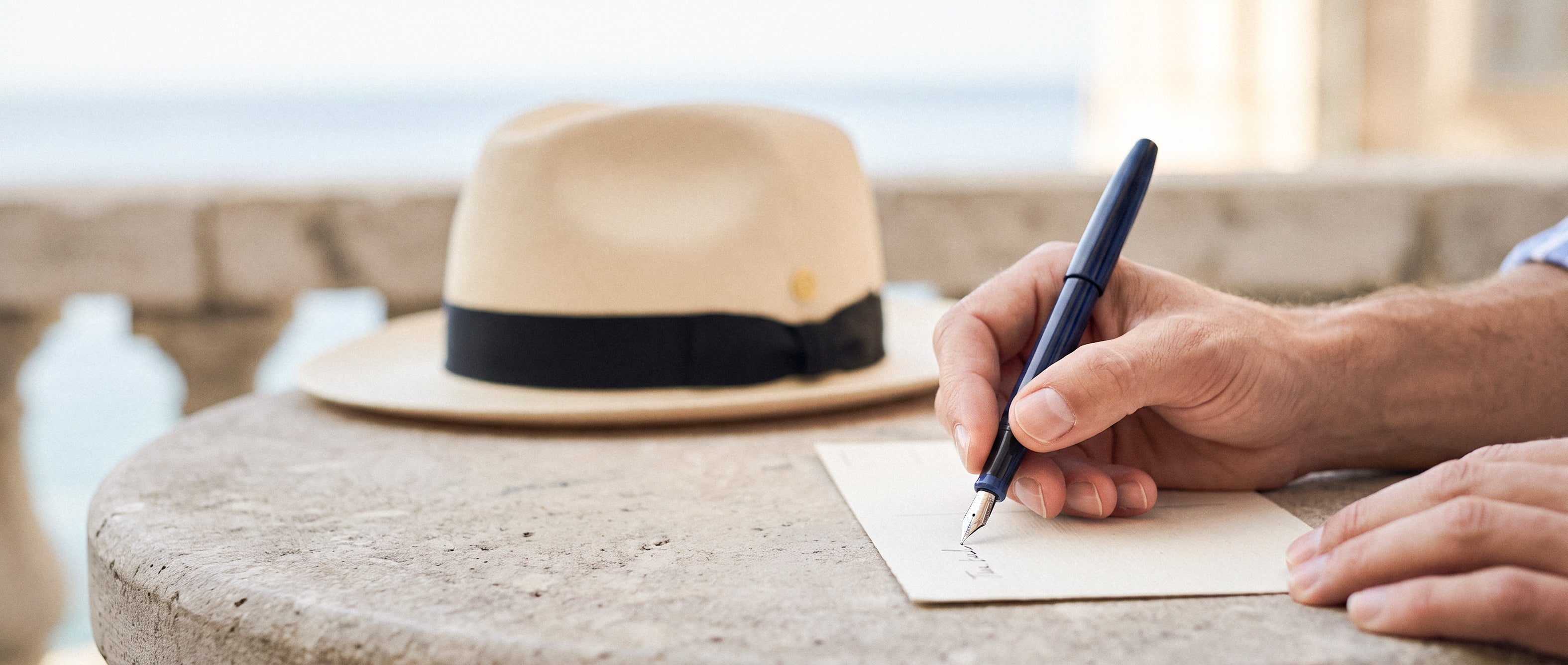

The Panama hat is one of the most iconic pieces of summer elegance. Light, breathable, refined and timeless, it has accompanied travellers, artists, statesmen and lovers of a natural yet sophisticated style for generations.
Yet, despite its name, the genuine Panama hat does not come from Panama. It is traditionally made in Ecuador from the fibres of toquilla straw. The name took hold over time because these hats were shipped via Panama, particularly during the construction of the canal, when they were widely worn and noticed.
At JJ Hat Center, expert hatters since 1911, we know that a Panama is far more than a summer hat. It is a piece shaped by rare expertise, precise craftsmanship and a tradition passed down from generation to generation. So, how is a Panama hat made? The answer can be summed up in a few words: by hand, with patience, rigour and respect for the material.
What is a genuine Panama hat?
A genuine Panama hat is hand-woven in Ecuador from toquilla straw. This natural fibre comes from a tropical plant whose young leaves are harvested, prepared and dried, then turned into supple, resilient strands.
A Panama is therefore not a hat shape, but a material and a craft. It can take on many silhouettes: fedora, traveller, colonial, optimo, trilby or wide-brimmed hat.
What sets a genuine Panama apart is the quality of its weave, the fineness of its straw, its lightness and its natural elegance.
Harvesting the toquilla straw
The making of a Panama hat begins with the harvesting of toquilla straw. Artisans select the young shoots of the plant, as they yield finer, more supple and more even fibres.
This first step is essential. The quality of the raw material directly influences the fineness of the weave, the suppleness of the hat, its appearance and its durability.
Once harvested, the leaves are opened, split into fibres and carefully prepared. The strands must be fine enough to allow a precise weave, yet strong enough to hold the structure of the hat.
Preparing the fibres
After harvesting, the toquilla fibres are generally cleaned, boiled and then dried. This process stabilises the straw, softens the fibres and reveals their natural colour.
Drying is a delicate stage. The fibres must be exposed in a controlled way to preserve their suppleness and evenness. They are then sorted according to quality, colour and fineness before being entrusted to the weavers.
For the finest Panamas, the selection of straw is extremely rigorous. The strands must be uniform, pale, supple and remarkably fine.
Hand weaving: the heart of the craft
Weaving is the most important stage in the making of a Panama hat. It is done entirely by hand, often by specialised artisans who have mastered the technique over many years.
Weaving usually begins at the centre of the crown and gradually works outwards. Each strand is worked with precision to create an even, supple and resilient structure.
The finer the weave, the longer the work. A simple Panama may take several hours or several days. A very fine Panama can require several weeks, sometimes more, depending on the complexity of the weave and the level of quality sought.
It is this patience that gives the Panama its unique character. Each hat bears the trace of a human hand, a rhythm and a craft tradition.
The fineness of the weave: a mark of quality
The quality of a Panama hat can often be recognised by the fineness and evenness of its weave. A tight, uniform and precise weave generally indicates a superior level of craftsmanship.
A finer Panama is often more supple, lighter and more elegant. Its surface is more even and its texture more refined. However, quality does not depend solely on the number of fibres or visible fineness: evenness, a well-balanced shape, the finish and the quality of the straw matter just as much.
A beautiful Panama should be comfortable to wear, well proportioned and naturally elegant.
Washing, drying and finishing
Once the weaving is complete, the raw hat goes through several finishing stages. It may be washed, dried, bleached or evened out, depending on traditional methods and the desired result.
The hat is then prepared to receive its final shape. This stage demands great precision, as the toquilla straw must be worked without being weakened.
The Panama is then pressed or shaped on a mould to create its silhouette: crown, brim, pinch, angle and volume. This is the moment the hat takes on its final look.
Blocking: giving the Panama its shape
Blocking gives the hat its definitive shape using dedicated hat blocks. The crown is structured, the brim is worked and the proportions are adjusted.
A Panama can thus become an elegant fedora, a more relaxed traveller, a highly protective wide-brimmed model or an optimo with classic charm.
This stage turns the raw weave into a true hat. It requires an expert eye, as a few millimetres can alter the overall balance of the silhouette.
The hatband and final finishing touches
After blocking, the hat receives its finishing touches: outer hatband, sweatband, and where applicable a bound edge, trim or specific details.
The hatband plays an important aesthetic role. It underlines the line of the hat, asserts its character and adds a touch of contrast or restraint. Black, brown, navy, natural or tone-on-tone, it can transform the look of a Panama.
The sweatband provides comfort and hold. It helps the hat sit better on the head and contributes to a pleasant fit.
The final finishes are carefully inspected: evenness of the brim, neatness of the weave, balance of the shape, comfort and overall elegance.
Why is the Panama so popular in summer?
The Panama hat is especially valued for its lightness and breathability. Toquilla straw allows air to circulate well while offering an elegant visual presence.
It is the ideal hat for sunny days, travel, strolls, café terraces, summer ceremonies or smart seasonal outfits.
It brings effortless elegance: distinguished, yet never excessive. It is this refined discretion that makes the Panama a timeless classic.
Does a Panama protect you from the sun?
Yes, a Panama hat can offer good sun protection, especially when it has a sufficiently wide brim and a dense weave.
Protection depends on several factors: brim width, density of the weave, thickness of the straw and the amount of light passing through the material. A very open-weave Panama will be more breathable but offer more limited protection. A tightly woven Panama will generally protect better.
For optimal sun protection, choose a Panama with a medium or wide brim and a dense, even material. For prolonged exposure, we still recommend pairing your hat with sunglasses and suitable sunscreen on exposed skin.
How to recognise a quality Panama
A quality Panama can be recognised by several details:
an even, harmonious weave;
supple straw that feels pleasant to the touch;
a well-balanced shape;
a clean, well-finished brim;
remarkable lightness;
meticulous finishing;
a natural, elegant look.
The quality of a Panama is not just a matter of fineness. A good hat must also be comfortable, suited to your style and well proportioned to your face.
How to care for a Panama hat
A Panama should be handled with care. It is best to hold it by the brim rather than by the pinch of the crown, to avoid weakening the straw at that point.
For everyday care, use a soft cloth or a soft brush to remove dust. Avoid water, excessive humidity and direct sources of heat.
When not being worn, your Panama should be stored in a dry place, away from strong light and ideally in a hat box. Proper storage preserves its shape and beauty season after season.
A hat born of the artisan’s hand
What makes the Panama so special is its deeply artisanal origin. Each hat is the result of a dialogue between material, hand and time.
In an age when so many objects are produced quickly, the Panama recalls the value of slow work, precision and tradition. It is not simply an accessory, but a piece shaped with patience.
To wear a Panama is to wear a story: that of Ecuadorian craftsmanship, a natural material and an elegance that transcends the ages.
Conclusion: the elegance of a timeless craft
A Panama hat is made from toquilla straw that is harvested, prepared, dried and then hand-woven in Ecuador. After weaving, the hat is washed, dried, shaped, blocked and carefully finished to become an elegant, light and durable piece.
Its making requires time, precision and true artisanal mastery. It is this rigour that makes the Panama one of the most admired hats in the world.
At JJ Hat Center France, we celebrate the Panama as an essential piece of summer elegance. Since 1911, our hatmaking expertise has guided us in selecting authentic, well-made hats designed to complement every silhouette with ease, distinction and character.